Are Pretzels Healthier Than Chips? A Side-by-Side Snack Comparison
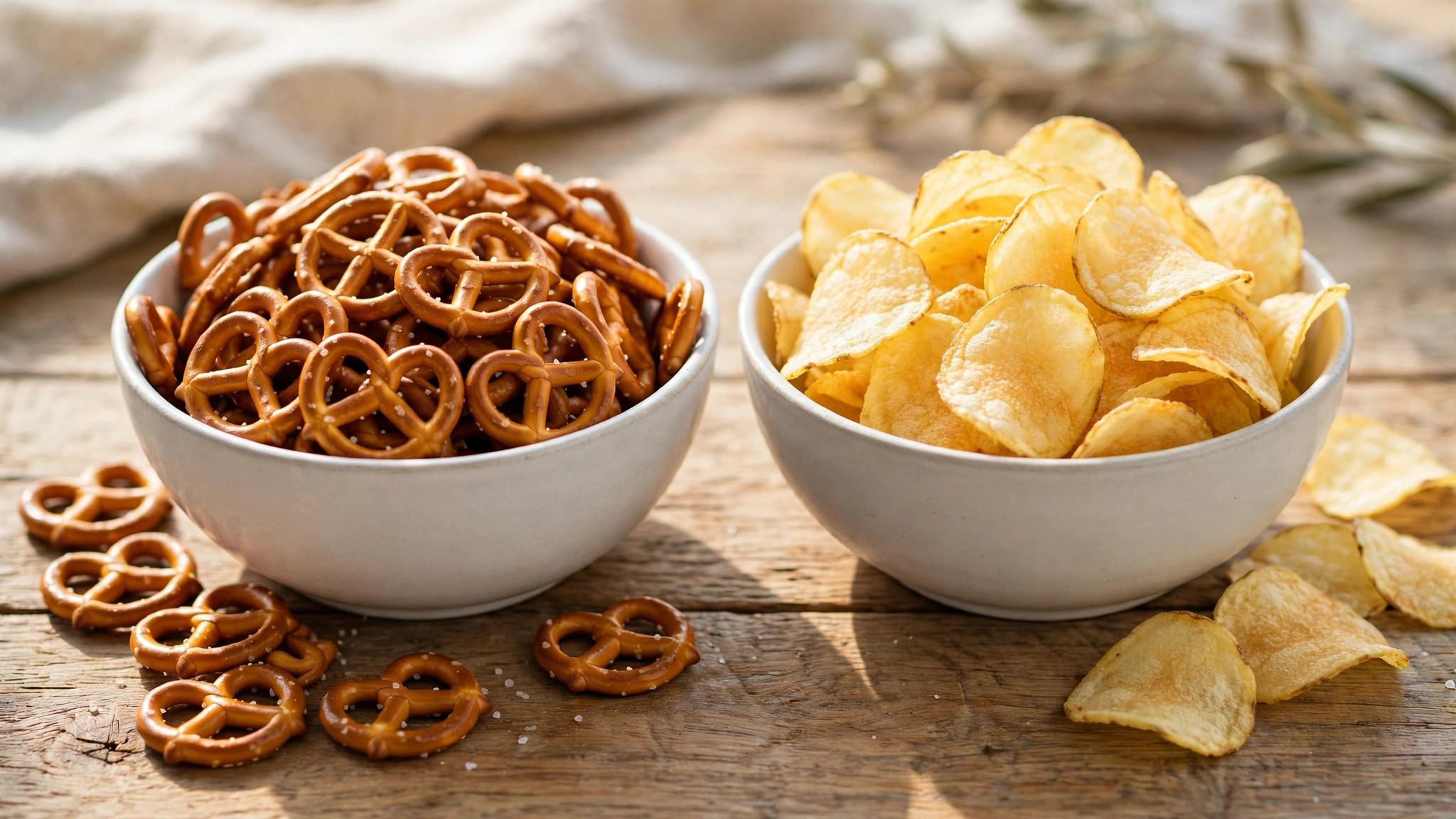
Short answer: pretzels are only slightly healthier than chips, and in some ways they are worse. Pretzels win clearly on fat and calories, because they are baked rather than fried. But they typically contain far more sodium, are made from refined flour with almost no fibre, and can raise blood sugar faster than chips do. If you are choosing between the two, pretzels edge it — but neither deserves its health halo or its villain status. Here is the full comparison.
The Side-by-Side Numbers
These are typical values for plain salted pretzels and standard potato chips, per 30 grams — about a small handful, or roughly 15 chips and a similar weight of mini pretzels. Exact figures vary by brand, so check your own packet, but the pattern is consistent.
| Per 30 g serving | Pretzels (salted) | Potato chips |
|---|---|---|
| Calories | About 110 kcal | About 150–160 kcal |
| Fat | About 1 g | About 9–10 g |
| Saturated fat | Less than 0.5 g | About 1 g (more in some brands) |
| Carbohydrates | About 23 g | About 15 g |
| Fibre | About 1 g | About 1 g |
| Protein | About 3 g | About 2 g |
| Sodium | About 350–450 mg | About 150–180 mg |
| Glycaemic index | High (around 80) | Moderate-high (around 55–60) |
Read the table by columns and pretzels look like the obvious winner: fewer calories, a tenth of the fat. Read it by rows and the story gets more complicated — pretzels deliver over twice the sodium and about 50% more carbohydrate, nearly all of it refined starch.
The Low-Fat Trap
Pretzels built their reputation in the low-fat era, when fat was considered the main enemy and anything baked and fat-free looked virtuous. That reputation has outlived the science. A food can be almost free of fat and still be a poor snack if what replaces the fat is refined flour and salt.
Pretzels are essentially baked white-flour dough with a salted crust. With about a gram of fibre per serving, their carbohydrate is absorbed quickly, and their high glycaemic index means they can spike blood sugar more sharply than the chips they are supposed to outclass. Chips, being cooked and served in fat, actually digest more slowly — one reason the table above surprises people.
There is also a fullness problem. Fat and protein slow eating and increase satisfaction; a fat-free, airy snack does neither. Many people find they eat a far larger pile of pretzels than they ever would of chips before feeling done, quietly erasing the calorie advantage.
Sodium: Where Pretzels Clearly Lose
The biggest gap in the table is sodium. A 30-gram serving of salted pretzels can contain 350–450 milligrams — and that is before you count the visible salt crystals that make up much of a pretzel’s appeal. Most health guidelines suggest keeping total daily sodium under about 2,300 milligrams, and lower (around 1,500 milligrams) is often advised for people watching their blood pressure.
At real-world portions, the numbers climb fast. A 100-gram bag of pretzels eaten in front of the television can deliver well over half a day’s sodium. Chips are by no means low in salt, but gram for gram they are usually the lesser problem. Flavoured versions of both snacks — cheese pretzels, barbecue chips — add more sodium still, along with extra additives.
So Which Should You Choose?
It depends on what you are managing:
- Watching total calories or fat? Pretzels, in a measured portion, are the better pick — baked beats fried.
- Watching blood pressure or salt intake? Chips are often lower in sodium per serving, and unsalted or lightly salted versions of either snack beat both standard options.
- Watching blood sugar? Neither is kind, but chips’ fat slows absorption, so pretzels are arguably the worse choice despite the lower calories.
- Just snacking occasionally? Honestly, choose the one you enjoy, in a portion you decided in advance. The health difference between the two is smaller than the difference portion size makes.
The single most effective upgrade is the same for both: pour a serving into a bowl instead of eating from the bag. It converts an open-ended snack into a measured one, which matters more than the pretzel-versus-chip decision itself.
Crunchy Snacks That Beat Both
If you snack on something crunchy most days, these options outperform both pretzels and chips on almost every row of the table:
- Air-popped popcorn — high volume and fibre for few calories; season it yourself to control the salt.
- Roasted chickpeas — fibre and protein together, which neither pretzels nor chips offer.
- A small handful of nuts — calorie-dense, but genuinely filling, so a small portion satisfies.
- Vegetable sticks with hummus — the crunch is real and the nutrition is in a different league.
- Whole-grain crackers — look for at least 3 grams of fibre per serving on the label.
Verdict: pretzels are the marginally healthier of two fairly unhealthy snacks — lower in fat and calories, higher in salt and refined carbs. Enjoy either occasionally and in a bowl, and reach for the swaps above when the crunch craving is a daily habit.
Related reading: Are Goldfish Healthier Than Chips? · Sodas Ranked by Sugar Content: How Sweet Is Too Sweet?
Frequently Asked Questions
Are pretzels good for weight loss?
They are lower in calories than chips per serving, which helps, but their low fibre and protein mean they are not very filling. If pretzels leave you raiding the kitchen an hour later, a smaller portion of a more satisfying snack may serve your goals better.
Why do pretzels have so much sodium?
Salt is part of what a pretzel is: the dough is typically treated before baking and finished with coarse salt crystals, and manufacturers also use salt for flavour in a food that contains almost no fat to carry taste.
Are baked chips healthier than pretzels?
They are closer than you might expect. Baked chips have less fat than fried chips and usually less sodium than pretzels, but they remain a refined, low-fibre snack. Check the label of the specific product — per-serving sodium and fibre tell you more than the “baked” claim.
Are whole-wheat pretzels a better choice?
Yes, modestly. Whole-wheat pretzels typically offer two to three times the fibre of standard pretzels, which slows digestion and improves fullness. The sodium, however, is usually just as high, so portion and frequency still matter.